
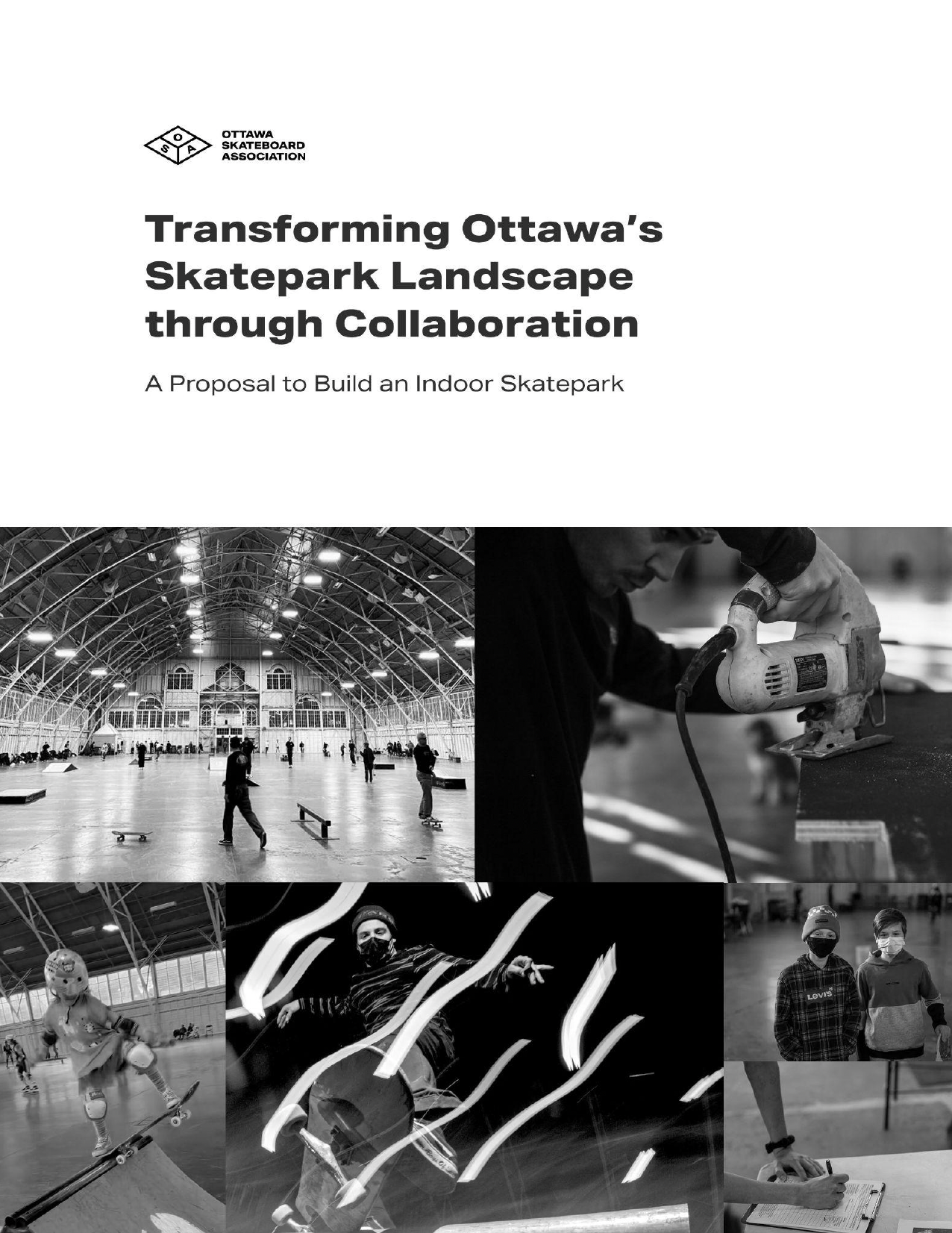
The OSA took a significant step forward by pitching a bold, forward-thinking public-private partnership to the City of Ottawa to address the critical lack of indoor skatepark facilities. This proposal laid out a sustainable, long-term solution for Ottawa’s growing wheeled action sports community.

Thanks to the tireless efforts of dedicated volunteers, the OSA successfully rallied community support, gathered a petition, and developed a formal report advocating for indoor spaces for 2025-2026 and beyond. While the journey continues, this milestone reflects the power of grassroots advocacy and the passion of Ottawa’s skateboarding community. A huge thanks to all the volunteers who made this progress possible!


Thank you to all the volunteers:

Aaron Cayer • Brendan Shaughnessy • Hayden Fox • Regan Coseni • Elizabeth Kim (+ Matt and Pippa) • Devan Ferguson (+ the whole Ottawa Longboarding Community) • Mark (from Surf Skate Ottawa) • Keara Dean • Shandril Mintenko • David Lepage-Facteau • Matt Gaudreau • Chelsea Currie • Quad Mob Ottawa • Chris Cormier • Paula Popescu • David Coyne • Jordan Wells • Ollie Acosta Pickering (+ Dawn Pickering) • Kyle Robertson • Marcos Duda • Anthony Sheculski • Everyone that joined our virtual and in-person meetings • Everyone that voiced their opinion on testimonial videos or messages • Top of the World • Joe Mamma’s • Rideau Rollers • Birling • OV Skateshop • and more!


The City of Ottawa, referred to as “the City,” currently boasts 18 free outdoor skateboard parks catering to residents in Kanata, Stittsville, Gloucester, Centertown, Conroy, Goulbourn, Orleans, Barrhaven, and Nepean. These parks vary in size and design, with the majority featuring prefabricated, modular wood/metal ramps set on an asphalt pad. Notably, only five of Ottawa’s skateboard parks are purpose-built by professional designers and builders.

Over the past few years, the Ottawa Skateboard Association (OSA) has collaborated with the skateboard community and the City to influence the design of new skateboard parks. The OSA firmly advocates for transitioning from an ad-hoc design and consultation method to a long-term, professionally developed skateboard park strategy. This strategy should encompass community-level development and introduce a city-wide implementation plan. The OSA believes that, with a relatively modest investment in planning and consultation compared to overall project costs, both the City and end users will benefit from high-quality, well-utilized skateboard parks befitting the Nation’s Capital. However, users of Ottawa’s skateboard parks express dissatisfaction with the current design and direction, feeling their concerns are disregarded.

To address this issue, the OSA recommends involving relevant and experienced design professionals, including landscape architects, planners, skateboarders, and community organizations, in developing a new Ottawa Skateboard Park Strategy, aligning with the City’s 2021 Parks and Recreation Master Plan. This strategy should prioritize users’ needs based on the recommendations and research outlined in this document, as well as input from direct users and community groups.

The following recommendations are detailed in this report:

  1. Solicit and develop a professional planning strategy, using this document as an anchor.
  2. Perform a City-wide Gap Analysis.
  3. Adopt robust site selection criteria, including thematic design considerations.
  4. Modify public consultation methods.
  5. Set aside funding for Life-Cycle considerations.
  6. Partner with community organizations.
  7. Increase the diversity of design professionals.

Our team believes that this document provides the City with an outline of an approach for Ottawa to become a champion of skateboarding in Canada and develop a network of parks benefiting the National Capital Region. This document outlines recommendations for developing a long-term skateboard park strategy for the skateboarders of Ottawa.

As another resource, the skateboard park project, has a great document on skateboard park standards that can be found here.

During the public consultation on the Kanata Richcraft development, the OSA found out that on any major city of Ottawa project that the city works on, any public project, 10% goes to a public art budget. So, it could be a fire station, the new library, the LRT, even a skatepark! The art component can be a request for proposals, or just a request for qualifications, which can be easier, because the concepts aren’t necessary.

The Kanata Richcraft development included funds for a skateboard park, and because the project was big enough there was also a budget for a public art component. Local artists Alisdair MacRae and Negar Seyfollahy won the commission for the public art. MacRae approached the Ottawa Skateboard community and asked for their input on what the skaters would like to see most. After some back and forth between several stakeholders, skaters suggest that the best use of the additional funds would be to add more skateboard park to the design. 

MacRae and Seyfollahy then worked closely with Ottawa skaters to include an additional design “sculpture” to the existing design of the skatepark. The OSA consulted with the local Kanata residents on what they thought was missing from the skateboard park and found that everyone wanted an obstacle that replicated some plaza elements. We settled on adding a granite ledge with lots of flat space – something that is often lost on large skateboard park designs. 

We are so happy to have worked with the artists to enhance the functionality of the Richcraft skateboard park by using the public funds to add more skate space to the skateboard park. Our community is ever so grateful to the understanding of our culture and contributions made to the skateboard community by Alisdair MacRae and Negar Seyfollahy. A Flat and a Box and the skate plaza opened to the public in July 2014.

Following the community consultation for the Bob MacQuarrie Skate Park (also known as the East District Skate Park) on February 18th, members of the Ottawa Skateboard Association met and discussed the proposed options. The OSA also supported the design consultation by sharing feedback forms with local skateboarders and collecting these feedback forms on behalf of skateboarders to submit to the city and the park designer. 

In addition to acting as a liaison between the community and the designers, the OSA also drafted a document highlighting our proposed modifications (including illustrations) we would like to see made to the proposed designs and our reasoning behind them. 

The purpose of this letter of support was to engage the City of Ottawa to form a partnership to build a DIY skateboard park. We proposed a partnership that would involve the design and construction of skate spaces to be  completed by the OSA, while the Department of Parks, Recreation and Cultural Services would be responsible for obtaining necessary permits for site development and construction in relation to the skateboard park. The Department of Parks, Recreation and Cultural Services would ensure that all of the OSA’s designs and builds during proposition and construction, including permanent and temporary features, meet acceptable standards of safety and would be subject to regular inspection in accordance with established procedures for comparable equipment. 

Once developed, any proposed alterations to the skateboard park structure by the OSA would be reviewed and approved by the City of Ottawa prior to construction. The Department of Parks, Recreation and Cultural Services would be responsible for costs associated with the installation, operation, and maintenance of the skateboard park as a recreation facility.

This was an immense opportunity to create a positive addition to the community, which will support an active lifestyle and healthy living among the youth in communities in the City of Ottawa. The OSA is ready to partner with the City of Ottawa to create this critical community infrastructure.

The purpose of this project was to lobby the city to build lighting at the Charlie Bowins skateboard park. Lighting at Charlie Bowins Skatepark will allow for increased use of the facility and decreased criminal activity. Through close consultations with communities of surrounding parks and users of the skate facilities, lighting and shading have come up as the most important demands. It has also been consistently brought up as a concern that none of Ottawa’s skate parks have lighting, and Charlie Park could serve as an illustration of how providing lighting to these facilities will reduce crime and provide optimal usability.

With the addition of lighting at Charlie Park, it will be the only facility with this amenity in the city. This will make this already popular park more accessible to users, as well as a model for how these public spaces, when provided with improved lighting, signal greater community investment leading to increased community pride, cohesion, informal social control and the fostering of community confidence. 

Thoughtfully designed lighting not only has the ability to prevent crime in parks, but will also ensure optimal use of Charlie Park. Primary users are kids and teens who often only have a few sparing hours before or after dinner and homework for recreational activity before the sun goes down. Management of sport needs to be positioned within the context of the lived experiences of today’s children and adolescents. This means fitting sports into lives that are not only time-challenged and highly dependent on technology, but also waning in other communal supports. Skateboarding and skateboard parks are a perfect fit to meet the changing youth culture and providing lighting for the facility will allow for optimal use given the time constraints for its primary users.

The City of Ottawa updates recreation standards and best practices over time and the OSA submitted suggestions with respect to skateboard park standards. The City of Ottawa did not consult the OSA or stakeholders when updating the standards for skateboard parks. Current standards for skateboard parks allow for prefabricated skateboard parks to be built in the city of Ottawa. The OSA responded by creating suggestions for updating the skateboard park standards policy. 

Our infrastructure standards have been split into two categories, with “Must Have” items being absolutely essential to the viability of a skateboard park, and “Should Have” items being of utmost importance but non essential.

Download Document

The purpose of this project was to evaluate the existing skateboard park infrastructure within Ottawa and provide recommendations to the municipal government for improving these facilities with respect to park quality, programming, access to transportation, and user engagement. 

The following overarching questions provided the basis for this evaluation: 

  1. Design and Build: Are these parks well designed and built? 
  2. Impact: Are these parks being used by the community groups they serve? 
  3. Programming: Are these facilities being leveraged by the City of Ottawa? 
  4. Life Cycle: What state are these parks in and what kind of upgrades or maintenance do they need to serve the community? 

Data for this evaluation was collected from the summer of 2018 to the fall of 2019. A direct survey of all municipal skateboard parks was conducted by a panel of skateboarders. This survey included site visits, facility testing, face-to-face user feedback, and interactions through social media platforms and email. 

This evaluation of Ottawa’s existing skateboard park infrastructure provides a snapshot of the current facilities in the city of Ottawa. Having a clear picture of the situation in this community can support a framework for building better skateboard parks and programming in the future.